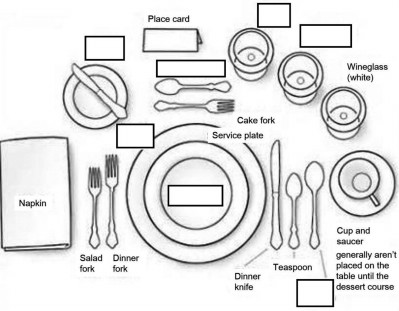
一、根据背景文章回答 ( ) 1. In Arabic countries you must be careful with your _____. A. feet B. mouth C. eyes D. hands ( ) 2. In Britain we try not to put our hands _____ during a meal. A. on the desk B. in the bed C. on the table D. in the pocket ( ) 3. Which of the following is true? A. In different countries, the manners are the same. B. Different countries have different manners. C. Good manners are not important. D. In Arabic countries we mustn’t be careful with our hands. ( ) 4. What’s the meaning of the underlined word “throughout”? A. 在……方面 B. 在……期间 C. 在……地方 D. 在……里面 ( ) 5. The main idea of this passage is _____. A. manners B. habits C. traffic D. lights 二、配对下列英语单词及中文含义 fork 菜肴 knife 甜点 plate 汤匙 dessert 刀 glass 叉 spoon 茶匙 course 盘子 teaspoon 玻璃杯 三、根据下列文章,将图片信息填写完整 Laying the Table Cutlery (餐具) Put forks on the left, and knives and soup spoons on the right. The different knives and forks are for the different courses. The small knife and fork are for the first course; the big ones are for the main course, and the small knife on the small plate is for butter or cheese. As a general rule, when you eat you start on the outside and move into the plate. The spoon and small fork at the top are for dessert. Plates The small plate is for bread and is always on the left. In the middle, there are usually some plates, and the smallest one is for salad. Glasses There are usually at least two glasses. They are on the tight, above the knives. They are water glass and wineglass.
|





 放大
放大 缩小
缩小 默认
默认 上一篇
上一篇 下一篇
下一篇